Green Building
Introduction
Q. What is a cool metal roof?
Q. What makes cool metal roofing a sustainable product?
Q. What are the recycled levels for steel roofing?
Q. What is Energy Star and how does it apply to cool metal roofing?
Q. Do cool metal roofs really save a building owner energy and money?
Q. What is LEED?
Q. What are photovoltaics and how do they relate to cool metal roofing?
Q. Are there codes or standards that I should be aware of when using cool metal roofing?
Q. What type of utility incentives exist for cool metal roofing?
In the United States, there are 100 million homes and 5 million commercial buildings that collectively use about 40% of the nation’s total energy (source: Pew Center on Global Climate Change). To a building owner, energy represents the single largest controllable operating expense. (source: Building Owners and Managers Association) Most of this energy is used for heating, air conditioning, lighting, heating water, computers and entertainment. A building’s roof can be the least energy efficient component of a building envelope. Combining these facts with the reality of increasing energy prices, it is no wonder that conservation measures and improved energy efficiency are becoming popular as important aspects of green building design. Green building design refers to the deliberate construction, operation and re-use or removal of the built environment in an energy-efficient and sustainable manner. According to McGraw Hill Construction, more than 75% of the architecture/engineer community is now involved in some way with green building.
Cool metal roofs can result in a significant reduction in cooling and heating energy use in a building. The Freedonia Group consulting firm estimates that the US roofing demand will reach close to 280 million squares by 2010, and that metal roofing will be one of the fastest growing products during that timeframe. Utility companies have become interested in cool metal roofing because it can help to reduce the peak demand in electricity during the afternoon hours in summer months, which prevents power disruptions. From an environmental point of view, cool metal roofing can also help to mitigate a phenomenon known as the heat island effect where urban areas experience higher air temperatures due to the abundance of non-reflective construction products and less vegetation.
The three main reasons for the growth of green building design and cool metal roofing are:
- Awareness of the environmental impact of buildings. Energy and water consumption, indoor air quality and waste generation are being optimized more than ever in the construction industry.
- Increasing cost of energy. Efficiency, conservation and renewable sources of energy are paramount to our nation’s future and reducing our dependence on foreign energy resources.
- Policies and incentives. Energy codes and standards are becoming more stringent and provisions for cool roofing are now commonplace. Utilities are establishing rebate and credit programs, and the federal government is offering tax incentives for the use of cool metal roofing. In addition, state and local governments are beginning to require that public building construction exceeds certain sustainability standards.
The list of green building labeling, certifying or rating programs grows daily. The main initiatives described on this webpage are Energy Star roof products program and the USGBC’s LEED program.
McElroy Metal is well positioned to offer a wide range of prepainted metal roofing products that meet the definition of cool roofing in many initiatives. This website is intended to provide building owners and designers with information on cool metal roofing and to show how McElroy Metal is involved in the green or sustainable building movement.
For more information visit:
www.pewclimate.org
www.boma.org
www.construction.com
www.freedoniagroup.com
[ back to top ]
Q. What is a cool metal roof?
A. Cool roofing is defined differently by various performance criteria in codes, standards, and incentive programs. In general, a cool roof is one that has relatively high solar reflectance and high thermal emittance.

During the daylight hours, a roof is constantly subjected to solar energy striking its surface. The term “Solar Reflectance” is a measure of the amount of that solar energy that is immediately reflected from the surface. It is not reflected heat, but reflected electromagnetic energy from the sun. Solar reflectance is reported as a decimal (0 – 1.00) or as a percentage (0-100%). The solar energy that is not reflected away from the surface is absorbed into the outer surface of the roof product and is converted into heat. The heat can be removed by convection as air flows over the surface, or by conduction through the roof material into the sheathing below. The energy that is left can also be re-emitted to the night sky in the form of infrared energy. That re-emitted energy is referred to as thermal emittance, which is also expressed as a decimal (0 – 1.00) or as a percentage (0-100%).
A cool metal roof with high solar reflectance and high thermal emittance would have a lower surface temperature as compared to a roof with low reflectance and low emittance. In the case of a cool metal roof, a lower surface temperature translates into less heat gain into the attic space or living space below the roof. The result is a cooler living space and lower cooling/heating energy consumption.
For more information visit:
[ back to top ]
Q. What makes cool metal roofing a sustainable product?
A. The EPA defines sustainability as “the ability to achieve continuing economic prosperity while protecting the natural systems of the planet and providing a high quality of life for its people.” Some may call this “environmental friendliness” or “ecological efficiency”.
Cool metal roofing is a sustainable building product for several reasons:
- Energy Efficiency. The radiative properties of cool metal roofing reduce the amount of heat transfer into the living or attic space below the roof, which in turn lowers air conditioning costs and energy production at the power plant. Studies have shown that a cool metal roof can save a building owner as much as 20% in their cooling energy costs. In addition, by reducing energy production at the power plants, greenhouse gases that are emitted in the production process are thereby reduced. Many metal roofing systems are Energy Star labeled and meet other cool roof requirements in codes and standards.
- Durability. Metal roofing has the greatest ability to perform over a long period of time in a wide range of weather conditions. Its proven longevity virtually eliminates the need to use future raw materials to produce roofing.
- Recycled Content. Most metal roofs have a high recycled content ranging from 25-95%, depending on the type. This is in stark contrast to conventional roofing materials which have much lower recycled content. The recycled content of metal has proven to be important to state and local municipalities listing metal as “green” in their solid waste districts or departments of natural resources.
- Recyclability. Metal roofing is 100% recyclable at the end of its useful life. This helps to eliminate the waste stream to landfills, where most conventional roofing products end up. Each year about 20 billion pounds of old composition roofing shingles are dumped into US landfills.
- Weight and Strength. Depending on the type of metal roof product and the gauge, metal roofing can be 1/8 the weight of conventional roofing shingles. As a result, metal roofing puts fewer loads on the structure and foundation design and extends the life of a building. The inherent strength of metal, combined with the light weight, provides building owners with the option of installing metal roofing directly over old roofing materials.
- Safety. Metal roofing and the exterior paint systems used with them are safe materials that pose no health risk. The surfaces are inert, with no gas emissions or allergens. The material is non combustible, and tested for wind resistance, fire resistance, and hail resistance.
For more information visit:
[ back to top ]
Q. What are the recycled levels for steel roofing?
A. Steel is the world’s most recycled material. New steel made with recycled material uses as little as 26% of the amount of energy that would be required to make steel from raw materials extracted from nature. Steel is produced using one of two processes; the basic oxygen furnace (BOF) or the electric arc furnace (EAF). According to the Steel Recycling Institute, the total recycled content to produce steel in the BOF process is about 30%, and the total recycled content to produce steel in the EAF process is about 95%. Recycled content can also be calculated in terms of “post-consumer” and “post-industrial” terms, which are often required in green building rating programs. The Steel Recycling Institute describes these calculations in detail.
For more information visit:
www.recycle-steel.org
www.aisc.org
www.metalconstruction.org/pubs
[ back to top ]
Q. What is Energy Star and how does it apply to cool metal roofing?
A. EPA’s Energy Star® program is familiar to many homeowners who see the label on appliances and electronic equipment. Energy Star now has a Roof Products component for cool roofing. A roof that meets the Energy Star performance requirements is considered one that is cool and helps to reduce urban heat island effects. The criteria for an Energy Star labeled roof are:
- For steep slope applications (greater than 2:12 pitch): initial minimum solar reflectance of 0.25, and 3-year aged minimum solar reflectance of 0.15.
- For low slope applications (2:12 or less pitch): initial minimum solar reflectance of 0.65 and 3-year aged minimum solar reflectance of 0.50.
Starting May 1, 2007, Energy Star will also require a minimum thermal emittance value of 0.75 for all roof products. In the new version products with thermal emittance below the min of 0.75 (ex. unpainted metal) can comply if they meet specific criteria for a value known as Solar Reflectance Index (SRI). The SRI value is determined by a complex calculation based on solar reflectance, thermal emittance and wind coefficients as described in ASTM E 1980. A user-friendly calculator for SRI can be found on the Cool Metal Roofing Coalition website.
Steel mills and paint companies provide McElroy Metal with the solar reflectance and thermal emittance values for the cool roof substrate and paint film components. This allows McElroy Metal to then label their specific products and colors on the Energy Star product directory.
For more information visit:
www.energystar.gov/index.cfm?c=roof_prods.pr_roof_products
www.coolmetalroofing.org/docs/SRIcalc9.xls
www.usgbc.org/LEED
[ back to top ]
Q. Do cool metal roofs really save a building owner energy and money?
A. Oak Ridge National Laboratory has developed calculators that estimate the energy savings of cool roofs compared to dark conventional roof products. The data from these calculators can give an indication of the savings that are possible with cool roofs. However, the real proof of how a cool roof can save energy is based on actual installations.
There are real-world case studies that demonstrate cool metal roofing’s ability to save money on cooling and heating bills. A Georgia school district constructed two identical 90,000 ft2 schools and maintained the thermostats at the district office. The construction of the schools was identical except for the type of roof. On one school, a prepainted metal roof from Architectural Metal Systems was installed with an Evergreen color (solar reflectance of 0.12) and on the second school, a prepainted metal roof was installed with the same color but featuring special pigments in the paint system that increased solar reflectance to 0.29. (paint systems were provided by BASF). After the first year of operation, the school district showed a $8000 savings in cooling/heating utilities at the school with the cool prepainted metal roof.
In another case study conducted in Florida in 2000, Florida Power Light in cooperation with Habitat for Humanity, studied homes with different types of roofs to determine the effect on the electricity cost. Habitat for Humanity built homes of identical size and floor plan with asphalt shingle, barrel tile, terra cotta tile, flat tile and painted metal. The homes were monitored over four months in the summer before they were occupied, and the thermostats were set at 72º F to maintain constant indoor air temperature. The white painted cool metal roof showed a 23% savings in cooling costs compared to the asphalt shingle roof. This was the highest savings of all the roof products tested.
For more information visit:
www.coolmetalroofing.org
www.ornl.gov/sci/roofs+walls/facts/SolarRadiationControl.htm
www.fpl.com
[ back to top ]
Q. What is LEED?
A. “LEED” is an acronym for Leadership in Energy and Environmental Design. It is a whole building certification rating system instituted by the US Green Building Council. In the LEED program, a building project is awarded points in categories for compliance with established sustainability standards. Architects, designers and building owners plan a project in order to acquire points in the program to achieve a level of certification for the building project. There are many LEED programs for different types of building projects. The flagship program, LEED-NC (New Construction), uses the following categories for a project:
- Sustainable Sites
- Water efficiency
- Energy/Atmosphere
- Materials/Resources
- Indoor environmental quality
- Innovation/Design process.
Each category awards points for compliance, with a total of 69 points available. LEED designates levels of certification as:
|
A cool metal roof can qualify for one point in Credit 7.2 of the Sustainable Sites category if it covers at least 75% of the roof surface area (excluding parapets, skylights and equipment) and meets the following criteria for SRI:
Low slope (≤ 2:12) min SRI of 78
Steep slope ( > 2:12) min SRI of 29
| Solar Reflectance, Thermal Emittance, and SRI Values for Kynar 500 Colors | ||||||||||||||||||||||||||||||||||||||||||||||||||||||||||||||||||||||||||||||||||||||||||||||||||||||||||||
|---|---|---|---|---|---|---|---|---|---|---|---|---|---|---|---|---|---|---|---|---|---|---|---|---|---|---|---|---|---|---|---|---|---|---|---|---|---|---|---|---|---|---|---|---|---|---|---|---|---|---|---|---|---|---|---|---|---|---|---|---|---|---|---|---|---|---|---|---|---|---|---|---|---|---|---|---|---|---|---|---|---|---|---|---|---|---|---|---|---|---|---|---|---|---|---|---|---|---|---|---|---|---|---|---|---|---|---|---|
|
||||||||||||||||||||||||||||||||||||||||||||||||||||||||||||||||||||||||||||||||||||||||||||||||||||||||||||
With the exception of Credit 7.2, a specific product can not qualify for a point in the LEED program. Instead, the whole building project receives points from green designs and processes. However, a cool metal roof can contribute to other points in the LEED program due to its recycled content, recyclability and energy efficiency. In the Materials/Resources category, cool metal roofing can contribute to the building’s weighted average recycled content for up to 2 points. The fact that metal is 100% recyclable helps with the construction waste management credit. The use of a cool metal roof can also contribute up to 10 points for the Energy Optimization credit in the category of Energy/Atmosphere.
A growing number of federal, state and local governments are requiring that public construction of buildings be LEED certified. In some cases, the requirement is at least a level of Silver certification. Even cities such as Washington DC, Pasadena, CA and Montgomery County, MD are now mandating that ALL new buildings, even those in the private sector, must meet LEED guidelines.
To download the McElroy Metal Leed Credit Documentation Sheet, click here.
For more information visit:
[ back to top ]
Q. What are photovoltaics and how do they relate to cool metal roofing?
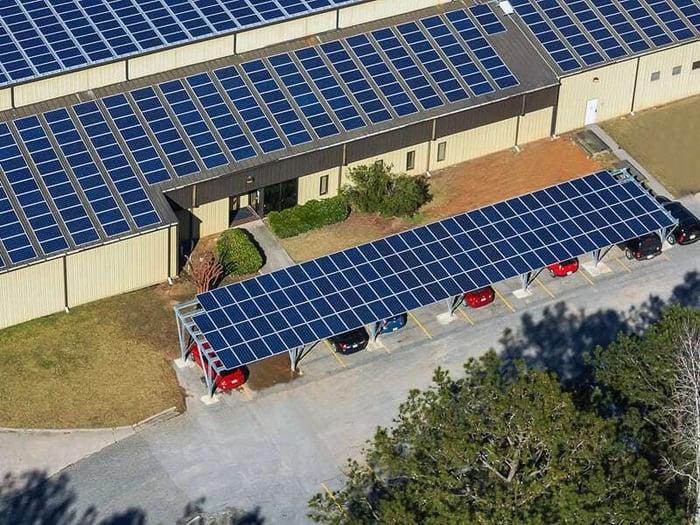
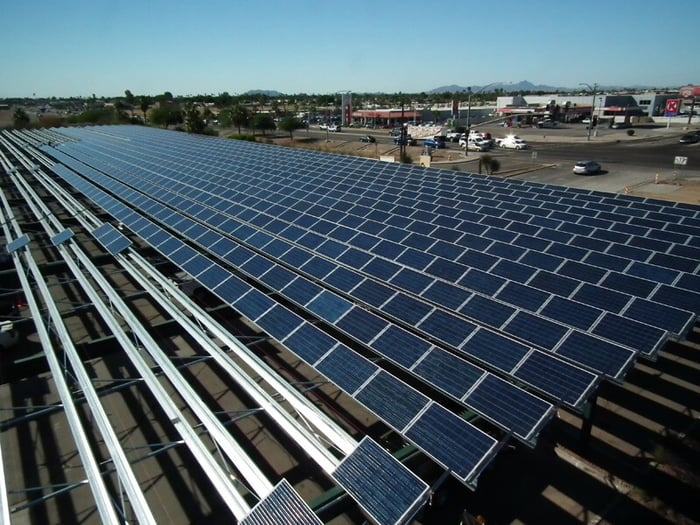
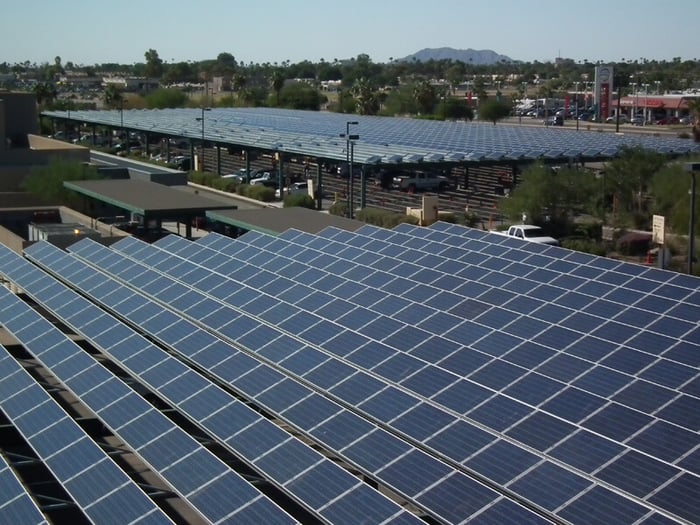
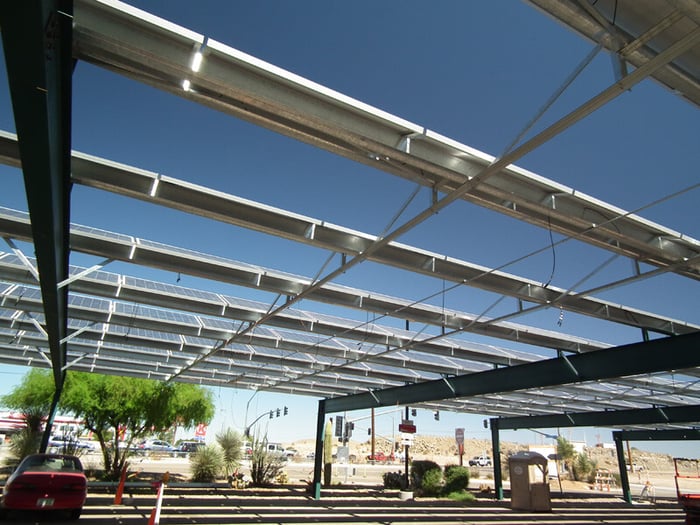
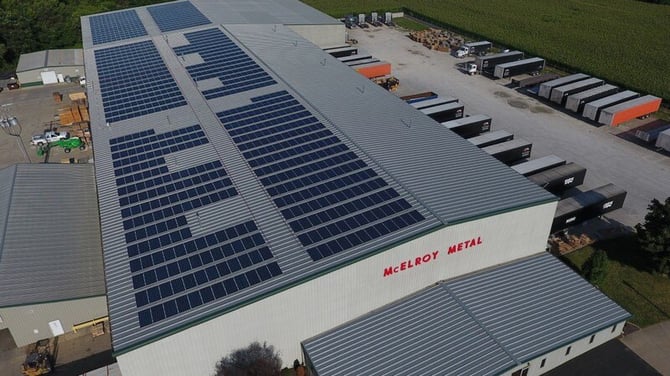
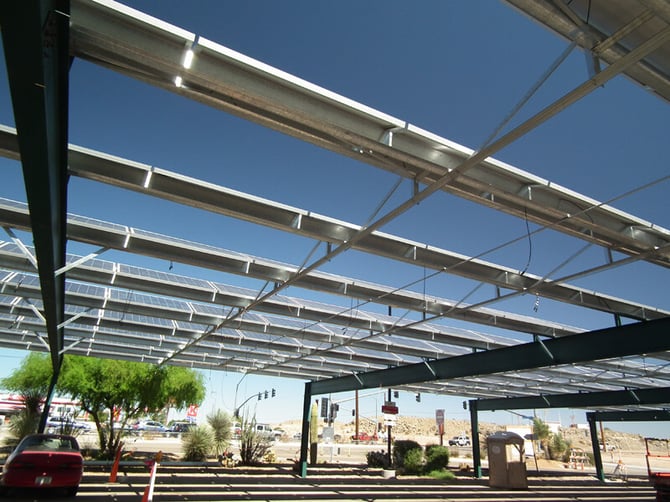
A. Photovoltaics (PV) are products that convert sunlight into electricity. They are commonly referred to as solar cells. PVs are made of semiconductor materials such as silicon. Cells of PV material are put together to form a module, and modules can be grouped together on roofs to form arrays which generate power to the building. There are two primary types of PV systems: Crystalline (mono and poly) and Amorphous. The crystalline systems consist of an array of silicon wafers sandwiched between two layers of glass. These panels can be heavy and must be attached to a roof using metal brackets or bracing. The amorphous silicon PV systems are flexible and light weight. A thin film of amorphous PV can be produced as a laminate to be adhered to the pan of a metal standing seam roof. In that case, the PV system is actually integrated into the building design and is almost unnoticeable on the roof. Metal roofing provides the best platform for the building integrated photovoltaic (BIPV) system. The synergy between the flexible PV and metal roofing products is causing an increasing use of the systems.
Both types of PV technology cost the same in terms of dollars per installed watt of power. More financial incentives are being offered by states for the use of PV technology. The Energy Policy Act of 2005 provides a credit equal to 30% of expenditures for the purchase of qualified PV equipment, up to $2,000.
For more information visit:
www.unisolar.com
www.nrel.gov/ncpv
www.solarelectricpower.org
[ back to top ]
Q. Are there codes or standards that I should be aware of when using cool metal roofing?
A. Yes, but it depends on what state or locality you are in. At the national level, the International Energy Conservation Code (IECC) references cool roofing. At the state level, most states have adopted some form of an energy code. In some cases, it is simply the IECC applied to their state. However, certain states have developed their own energy standards in a building code. The Alliance to Save Energy’s website contains state-by-state information on the latest developments in state and regional energy codes.
California has created a unique but complex energy efficiency standard in their building code, referred to as Title 24. The 2005 version of Title 24 has prescriptive and performance based provisions for cool roofing used on low slope commercial buildings. The 2008 version of Title 24 will include similar provisions for steep slope and residential roofing. The exact provisions of the 2008 version are not yet known, but the final standards are expected to be complete before the end of 2007.
Chicago has an energy code with provisions for cool roofing in the section on Urban Heat Island. At present, any low slope (≤2:12) roofing project in the city must have a minimum initial solar reflectance of 0.52 and a three-year aged reflectance of 0.40. This performance criterion will change as of September 1, 2008 when the reflectance requirements will match those of the Energy Star program at that time. For moderate slope (2:12 to 5:12) roofing projects, the requirement for minimum initial solar reflectance AND aged reflectance is 0.15. There are no steep slope performance requirements.
ASHRAE 90.1 and 90.2 include cool roof provisions as insulation credits. Standard 90.1 covers commercial roofing, and the criteria for cool roofing are min solar reflectance of 0.70 and min thermal emittance of 0.75. In Standard 90.2 which covers residential roofing, the criteria are min solar reflectance of 0.65 and min thermal emittance of 0.75. In both cases, the standard allows for a credit in insulation R-value if a cool roof, as defined by ASHRAE, is used. This applies primarily in the southern tier states.
For more information visit:
www.ashrae.org
www.energy.ca.gov
www.chicagocodes.com
www.ase.org
www.coolmetalroofing.org
www.naseo.org
[ back to top ]
Q. What type of utility incentives exist for cool metal roofing?
A. Examples of some utility incentives can be found in California and in Florida. In California, Pacific Gas & Electric (PGE) launched a residential cool roof rebate program in September 2006. It is a two-tiered program offering customers who install a cool roof to receive a $0.10/ft2 rebate if the solar reflectance is between 0.25 and 0.39, with min emittance of 0.75. In addition, a $0.20/ft2 rebate is available if the solar reflectance was 0.40 or higher, and min emittance was 0.75. A residential low slope roof rebate program also exists with PGE.
Another California steep slope residential rebate program was launched in January 2007 by Southern California Edison (SCE). That program is similar to the PGE program in that a two-tiered rebate system, with identical cool roof criteria and monetary rewards as those used by PGE, is used. The SCE program applies to customers in different climate zones compared to the PGE program.
In Florida, Florida Power Light (FPL) offers their residential customers a rebate program for cool roofing. Initially, the program offered rebates of $0.10/ft2 for cool roofing as defined as solar reflectance of 0.65 for metal roofing. In November 2006, FPL modified their program to offer a homeowner a flat rebate of $325 for installing an eligible cool metal roof and $200 to the contractor for selling an eligible cool metal roof.
Incentives from federal and state government agencies are also available for promoting energy efficiency. The Database of State Incentives for Renewables and Efficiency is a good resource for these types of programs.
For more information visit:
www.pge.com/res/rebates/cool_roof/index.html
www.sce.com/rebatesandsavings/residential/_Heating+and+cooling/coolroof/
www.fpl.com/doingbusiness/contractors/pdf/residential_building_envelope.pdf
www.dsireusa.org
[ back to top ]